
The bloodwork your oncologist may not be ordering, but should.
The oncologist is tracking the tumor, but who’s tracking the metabolic fire that may be feeding it? If no one is tracking it, no one is fixing it, and that is the part you can change.
Watch Dr. Thomas’s free 45-minute presentationStandard oncology bloodwork isn’t designed to capture metabolic biomarkers associated with cancer progression, treatment resistance, and disease recurrence. Dr. Daniel Thomas orders a panel of 35 of these important markers, then builds a personalized treatment plan around the results.
Treatment targets the tumor. It does not change the metabolic conditions that helped it grow, or that remain if it returns.
Cancer does not exist in a vacuum
The body’s metabolic environment can either feed the cancer or help starve it.
Cancer generally does not arise in a truly healthy body. You can be fit on the outside yet sick on the inside. Looking well and feeling well can be falsely reassuring, because they are not the best measure of health. What is happening beneath the surface is, and it can be measured. That inner environment is shaped by the body’s own metabolism and, in most cases, it can be changed.
Throughout treatment, oncologists track a basic panel of labs, largely to catch side effects and help keep the treatment as safe as possible. But there is a much bigger picture that too often goes unseen.
Every cell in the body is surrounded by conditions it did not choose, such as the level of insulin circulating in the blood, the degree of chronic inflammation, and how much oxygen reaches the tissue. In cancer, these conditions fall into two nested layers. Some reflect the tumor microenvironment, the immediate pocket surrounding the cancer, a complex mix of cancerous and noncancerous cells, each with its own distinct metabolism. Others reflect the tumor macroenvironment, the whole-body metabolic state that this pocket sits within. Cancer is not only a tumor-local event, but also a whole-body metabolic one, and the macroenvironment largely determines the microenvironment. Together they form the metabolic environment (also known as the “terrain”), and a growing body of evidence indicates that it can drive tumor initiation, growth, spread, treatment resistance, and disease recurrence.
This reframes a central question in oncology. Alongside asking what is happening inside the cancer cell, it asks what the body is supplying to that cell, and whether that environment can be changed. That second question is every bit as consequential, yet it is the one most often left unasked. For many patients, it is also where they hold the most influence.
When the metabolic environment goes unmanaged, it can quietly undermine cancer treatment and recovery. Patients in active treatment may be fighting the disease with one hand while their own metabolism works against them with the other. And patients told they are in remission may be walking around in a body metabolically primed for cancer recurrence. Simply put, pursuing treatment or lasting remission without measuring and managing the metabolic conditions driving the disease is the very essence of placing the cart before the horse. The encouraging part is that these conditions are measurable, and most can be improved once identified, which may give your treatment a better chance to work.
Stop feeding the fire
Treatment is necessary work, but it is incomplete work if the metabolic environment that allowed the tumor to take root, and that will be present if it returns, remains untouched.
… the cancer can return.
“I recently reviewed labs for a patient whose oncologist had declared her in remission. Her standard bloodwork looked fine. But her fasting insulin was 22 uIU/mL, hs-CRP was 4.8 mg/L, vitamin D was 24 ng/mL, and her neutrophil-to-lymphocyte ratio was 4.1. She was metabolically still feeding the fire, and no one had told her. Those four numbers gave us a real, measurable place to start. Her case is not unusual. After 40 years of reviewing cancer patient labs, I still see the same gaps in the vast majority of standard oncology panels.”
Each of these markers (fasting insulin, hs-CRP, vitamin D, neutrophil-to-lymphocyte ratio) has been studied in relation to cancer survival. The research behind them is linked in the references.
Identify the fuel
Six metabolic fuels that feed cancer growth
Standard oncology often misses the very conditions that make cancer resistant to treatment. Left unmanaged, they do something specific: they create ideal soil for cancer to grow. These six are measurable, and in most cases modifiable.
Insulin Resistance
Chronically high insulin acts as a steady growth signal through the IGF-1 axis, long before standard glucose tests flag a problem.
Chronic Inflammation
A high hs-CRP and NLR create a pro-cancer environment throughout the body that tumors use to build locally.
Oxidative Stress
Oxidized lipids and excess iron damage DNA, proteins, and fats, the kind of injury that helps start cancer and resist treatment.
Hormonal Imbalances
Low active thyroid and elevated cortisol hold metabolism in a stress posture that suppresses immune surveillance.
Nutritional Deficiencies & Excess
Low vitamin D is one of the most correctable deficiencies in medicine, while excess B12 can amplify the growth signaling cancer relies on.
Interstitial Fluid Acidity
An acidic environment around cancer cells can suppress immune activity, promote invasion, and increase treatment resistance.
Why optimize these markers
The aim is a metabolic environment less hospitable to cancer.
Measuring and correcting these markers is not about chasing numbers for their own sake. The purpose is to change the body’s internal conditions, because research links a healthier metabolic environment to six outcomes that matter most in cancer care.
Reversing tumor progression
Creating an environment less hospitable to cancer’s growth and spread, and more conducive to remission.
Decreasing treatment resistance
Fewer of the inflammatory, insulin-driven signals cancer exploits to adapt and survive.
Reducing treatment toxicity
A more resilient metabolic environment helps healthy cells better withstand the collateral effects of treatment.
Enhancing immune surveillance
Strengthening the body’s ability to recognize, target, and clear cancer cells throughout treatment and long after it ends.
Improving treatment outcomes
Conditions in which chemotherapy, radiation, and immunotherapy can do their job better.
Lessening the risk of recurrence
A body that does not resemble the one in which the cancer first took hold.
Whatever treatment path you choose—whether conventional or integrative (combining conventional treatment with evidence-based complementary approaches)—optimizing these markers is important. It does not replace your treatment, but lays the groundwork by creating a metabolic environment that gives that treatment a better chance to work. Every recommendation is made with your current treatment in mind, and chosen to support it, not to work against it. Optimizing these markers cannot guarantee a cure or any particular result, but it addresses variables that are otherwise left to chance. In a disease with so much outside your control, these are among the few things that are not.
The blueprint
What a comprehensive metabolic panel actually measures
Every treatment decision, conventional or integrative, is made in a body with a particular metabolic environment, and that environment either supports the treatment or works against it. Measuring it first turns the part of your care you can actually influence into something visible, specific, and trackable, and it is the first step toward making that environment less hospitable to cancer.
The protocol is never a template. It is built directly from what your specific bloodwork reveals. The labs are the blueprint, and without them every recommendation would be a guess. You don’t need to understand every marker below; that is Dr. Thomas’s work. This is simply the full picture of what gets measured and why each piece matters. The real value is not in the data alone, but in the expert interpretation.
Glucose Regulation
Fasting glucose, fasting insulin, HOMA-IR, hemoglobin A1c, GlycoMark, and C-peptide reveal how strongly glucose handling may be supporting tumor growth.
Growth Signaling
IGF-1 is one of the body’s most potent growth signals. Too high presses the accelerator on cellular growth. Too low can lead to muscle wasting. Balance requires testing, not guessing.
Inflammatory Markers
CRP-to-albumin ratio and interleukin-6 (IL-6) measure cancer-relevant inflammation. Elevated levels are linked to faster progression and shorter survival across most cancers.
Immune Ratios
Ratios drawn from numbers already on a standard CBC, yet rarely calculated. Elevated neutrophil-to-lymphocyte and platelet-to-lymphocyte ratios are associated with poorer outcomes across many cancers.
Lipids
ApoB, oxidized LDL, and the triglyceride-to-HDL ratio reveal whether circulating cholesterol is not just excessive but actively damaging cellular machinery.
Minerals
Excess iron drives the metabolic machinery tumors use to multiply quickly. Excess copper can fuel the angiogenesis that lets them grow beyond a pinhead. Magnesium deficiency weakens DNA repair, heightens inflammation, and reduces immune surveillance.
Coagulation
D-dimer and fibrinogen reveal whether the clotting system is being recruited by the disease to shield tumor cells and facilitate metastasis.
Hormones
Low thyroid weakens the immune system’s ability to spot abnormal cells. High cortisol suppresses defenses and shifts metabolism toward tumor growth. Excess estrogen, testosterone, DHEA, and leptin drive growth, inflammation, and blood-vessel formation, creating an environment that helps cancer grow, spread, and resist treatment.
Vitamins
Excess B12 can amplify growth signaling cancer relies on. Low vitamin D is associated with higher cancer-specific mortality.
Tissue Hypoxia & Metabolic Stress
Hemoglobin, lactic acid, LDH, serum CO2, the AST-to-ALT ratio, uric acid, GGT, and G6PD, when outside their optimal ranges, indicate tissue hypoxia and a metabolic shift toward a high-stress, low-oxygen environment that can harm normal cells and help cancer cells thrive and resist treatment.
Cellular Stress
Galectin-3 rises when cells are under chronic stress. When it stays high, it drives inflammation and helps tumors stiffen the surrounding tissue, making it harder for the immune system to reach and clear cancer cells.
Interstitial Fluid pH
Urine pH is a window into the interstitium, the body-wide fluid network around every cell. A more alkaline interstitial pH signals a tissue environment that is less supportive of tumor progression.
To learn more about the scientific rationale for the above tests, click here.
Normal vs. Optimal
A “normal” result can still be feeding the fire
The reference ranges most labs rely on can look reassuring while masking the very metabolic conditions that can quietly undermine cancer treatment and recovery.
Built from the general population
Standard reference ranges are built from population averages that include large numbers of people who are metabolically unwell. A fasting insulin of 20 uIU/mL is technically “normal,” yet can reflect genuine insulin resistance. Falling within normal often means only that you are no sicker than the average American, a disturbingly low bar.
Targets the lowest disease risk
Optimal ranges are drawn from published research and clinical experience that identify the levels tied to the lowest risk and best outcomes. But numbers do not interpret themselves: the same insulin means something different alongside a high IGF-1 than a low one. That interpretive lens is cancer-specific metabolic medicine, not standard functional medicine.
What progress looks like
A quiet return of things you had forgotten were missing.
In our experience, many patients describe a gradual return rather than a single dramatic moment, though everyone’s course is different. The goal is not only to move these numbers in the right direction, but to keep them there.
The most meaningful change is often not a number on a lab report. It is the shift from feeling like a passenger in a process being done to you to an active participant in a plan you understand and can discuss with your team.
- Energy returns first in small increments, often in ways family members notice before you do.
- The aches, the mental fog, and the persistent sense that the body is working against itself begin to ease.
- Sleep deepens, and body composition shifts in the direction it is supposed to shift.
- Fasting insulin and hs-CRP fall, the neutrophil-to-lymphocyte ratio comes down, and vitamin D climbs into the range where immune surveillance begins to work better.
- Tracked over 3-6 months of targeted support, the trajectory becomes recognizable.


Fall 2027
Who is Dr. Thomas
Four decades of practice, devoted to the science of metabolic medicine and integrative cancer care.
Dr. Thomas is a highly regarded and sought-after physician whose medical expertise has been shaped by extensive education and refined over 40 years of clinical practice. His work centers on the science of metabolic medicine, longevity, and finding and addressing the measurable cancer drivers and the treatment resistance mechanisms that standard oncology leaves unexamined.
His strength lies in his scientific curiosity, creative and analytical thinking, and practical application of cutting-edge research. Despite the demands of a busy medical practice, Dr. Thomas devotes 20-30 hours a week outside the office to reviewing the latest scientific literature and consulting with leading scientists to help identify promising treatments.
He shares his evidence-based insights at ThomasHealthBlog.com and in his forthcoming book, “Healthier After 50: A Smarter Path to Aging Well,” co-authored with his wife, Dr. Sylvia Torres-Thomas, which will distill their decades of clinical wisdom into a practical guide for living healthier, happier, and longer.
Education & Background
Credentials
A foundation spanning biochemistry and osteopathic medicine, and post-doctoral training in metabolic, nutritional, and cancer-focused integrative medicine.
- Fellowship, Integrative Cancer TherapiesMetabolic Medical Institute, Boca Raton, Florida2016
- Graduate Certificate, Brain Fitness and Memory ManagementUniversity of South Florida Morsani College of Medicine2016
- Graduate Certificate, Metabolic EndocrinologyUniversity of South Florida Morsani College of Medicine2014
- Certificate, Plant-Based NutritionCornell University T. Colin Campbell Center for Nutritional Studies2014
- Master of Science, Metabolic and Nutritional MedicineUniversity of South Florida Morsani College of Medicine2012
- Hospital Rotating InternshipNorthwest General Hospital, Milwaukee, Wisconsin1987
- Doctor of Osteopathic Medicine (D.O.)Des Moines University College of Osteopathic Medicine1986
- Bachelor of Science, BiochemistryAndrews University, Berrien Springs, Michigan1982
To learn more about Dr. Thomas’s background, visit MyDoctorThomas.com.
Watch the free presentation
Integrative cancer care, alongside your conventional treatment.
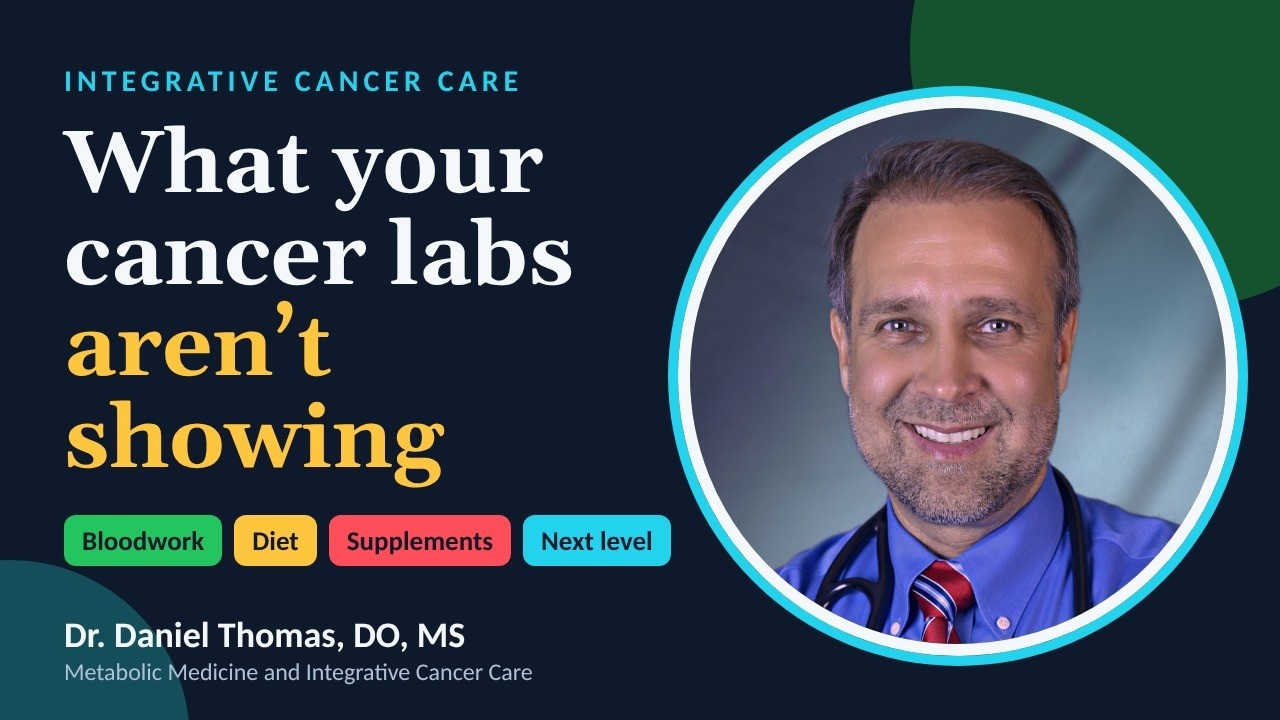
In this 45-minute presentation, Dr. Thomas walks through both halves of this work in plain language. You will learn how the metabolic environment is measured and improved, which common supplements may work against your treatment, and the ways cancer learns to survive treatment, along with what can be done about each one.
Jump to a topic
Prefer to watch on YouTube? Open the video on YouTube. Like everything on this page, the presentation is educational and is meant to work alongside your oncology care, never in place of it.
Is this consultation right for you?
You’re currently in treatment
- Want every treatment cycle delivered into the most favorable metabolic environment possible
- Suspect your standard bloodwork isn’t telling the full story
- Need clear, written guidance to bring to your next oncology visit
- Aren’t sure which of your supplements are helping and which may be counterproductive
You’ve been told you’re clear
- Want to maintain remission by being proactive, especially during the high-risk recurrence period
- Sense the underlying metabolic environment was never addressed
- Prefer being an informed participant in your long-term plan
- Would value a metabolic baseline you can track over time
Family members researching on behalf of a loved one are warmly welcomed. Many consultations begin with a spouse, adult child, or sibling who started looking before the patient was ready.
Three tests versus thirty-five
A standard oncology “comprehensive” panel measures a fraction of what shapes the disease.
Standard oncology bloodwork typically includes
3tests
Comprehensive Metabolic Panel (CMP)
Tumor marker (e.g., PSA, CA-125, CEA)
Our metabolic panel includes
35tests
Covering the metabolic conditions that shape a tumor’s environment, from the tissue around it to the whole body.
The “Comprehensive Metabolic Panel (CMP)” is comprehensive in name only. It measures glucose, electrolytes, kidney, and liver values. Important, but not thorough enough to uncover the metabolic drivers that shape a tumor’s environment, from the surrounding tissue to the whole body.
This is information most cancer patients never get to see.
Take the next step
An in-depth consultation to map the metabolic environment standard oncology leaves unexamined
What’s included
Built entirely from what your specific bloodwork reveals, and designed to coordinate with, not compete with, your treating oncology team.
- A comprehensive lab order covering the full set of cancer-relevant biomarkers described above.
- A two-hour consultation, unhurried by design, to go through the labs together and weigh how the findings affect you.
- A detailed written report you keep built specifically from your bloodwork, not a generic template, a marker-by-marker plan with your personal optimal target for each value and how to work toward them, covering dietary strategies, lifestyle changes, and targeted supplementation, each chosen for your case and ready to act on, along with possible repurposed medication options to discuss with your medical team.
- A full review of your current supplements, identifying which ones are helping, which are doing nothing, and which may actually be shielding cancer cells from the very mechanisms intended to kill them. When it comes to supplements, knowing what not to take is just as important as knowing what to take.
- A one-hour follow-up appointment three months later, included at no additional cost, to recheck your bloodwork and assess how the changes are taking hold. This visit is where the plan proves itself. Optimal targets are rarely reached in a single step, and seeing which markers moved, which did not, and why is what turns a set of recommendations into a course correction.
Includes the two-hour consultation, your written report, and the three-month follow-up appointment.
Complete the patient form →Fill out the quick online form, and we’ll be in touch to schedule.
The full two hours are deliberately unrushed, deep enough to go through the specific labs, weigh the interactions between findings, and answer your questions, which standard oncology visits rarely have time to address. The time itself, however, is only part of what patients are paying for. They are paying for Dr. Thomas’s experience, expertise, and judgment regarding which numbers matter in their specific case, which considerations are worth pursuing with their medical team, and which are not. The aim is to give a patient something rarely offered after diagnosis: a precise, written read on what their own metabolism is doing, and a plan to change it.
“If, during the two-hour consultation, I do not identify at least three actionable metabolic drivers worth addressing in your case, your consultation fee will be refunded in full. After 40 years of practice, I have yet to review a panel on a cancer patient and not find meaningful targets for intervention.”
The cost of waiting
In many solid tumors, most recurrences happen within 2-3 years, the exact window these drivers go unwatched.
In active treatment, every cycle is delivered into a metabolic environment that is either working for you or against you, and those conditions do not pause for an infusion schedule. It is natural to plan on addressing all of this once treatment is behind you. But the cycles happening now are the ones that environment is shaping, and each one is an opportunity that does not come back.
Remission means the absence of detectable disease. It does not mean the body that produced it has changed. The highest-risk window for recurrence in many solid tumors falls within the first 2-3 years after treatment. That is the one window where correcting these drivers matters most, and for most patients it passes with no one measuring them at all. Left unaddressed, they tend to reinforce themselves rather than hold steady.
You cannot correct what you never measured. The drivers left unexamined now are the ones you will wish you had known about later. Proactively managing the metabolic environment is how you get ahead of that window instead of looking back at it.
Common questions
If this bloodwork is so important, why hasn’t my oncologist already done it?
Will this replace my oncologist?
Can I just order these labs myself?
What kinds of cancer do you work with?
Is the consultation available remotely?
What if I had labs drawn recently?
Does Dr. Thomas prescribe medications, or only make recommendations?
Much of what shapes the metabolic environment can be addressed through diet, lifestyle, and targeted supplementation, and for most patients these form the foundation of the plan. In select cases, however, such as patients with aggressive, late-stage, treatment-resistant, or recurrent cancer, repurposed/off-label prescription medications may be recommended.
If the medications cannot be prescribed and managed by a patient’s own oncology team, Dr. Thomas may, at his discretion, take on prescribing and closely monitoring the medications himself. This carries additional fees that reflect the added time and oversight involved, and requires a physical examination at our Florida office before starting.
Do you accept insurance or Medicare?
Does the consultation fee include the cost of the bloodwork?
What is the cost of additional follow-up appointments?
How quickly can I schedule?
Do not leave your metabolic health to chance
Cancer treatment that leaves your metabolic health unaddressed allows conditions driving the disease to persist. The choice is yours.
The sooner you uncover what may be feeding the fire, the sooner you can start putting it out.
Complete the quick online Prospective Patient Form, and we’ll be in touch to schedule.